
EV charging canopy planning
EV Charger Shades for Saudi Projects: Planning Supplier Interfaces
· Shades Systems
An EV charging canopy covers a space where a driver must reach the charger, connect a vehicle and handle a cable. For commercial developments, offices and fleet sites, its layout should therefore be coordinated with equipment, pedestrian access and maintenance before the steelwork is fabricated. This guide helps owners and consultants define supplier interfaces; it is not an electrical design or a substitute for the equipment instructions and Saudi requirements applicable to the project.
Start with a coordinated parking layout
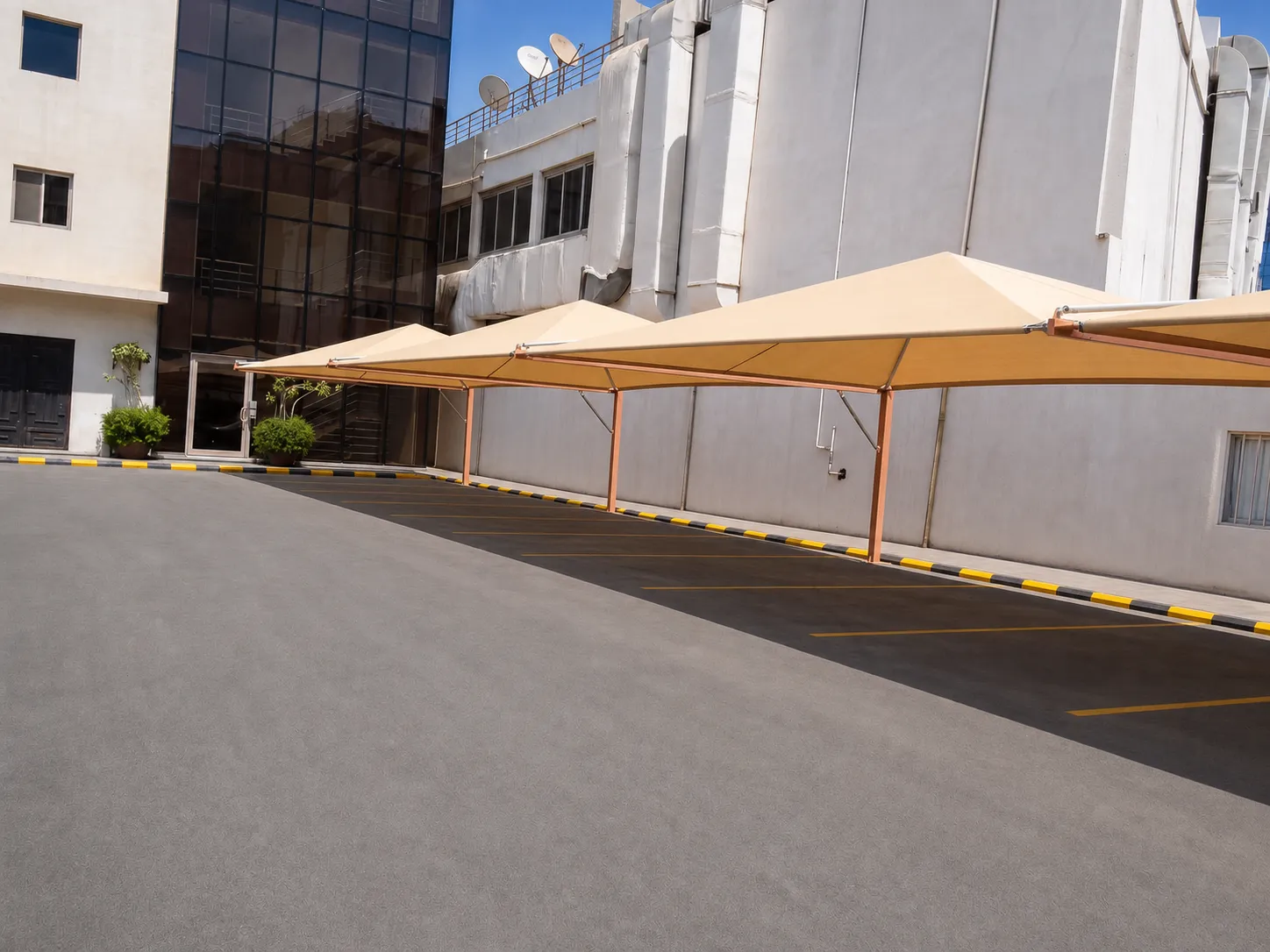
Review vehicle orientation, charging-port locations, charger position and canopy columns together. A column can conflict with a door even when it sits outside the vehicle outline. A foundation can also conflict with buried services or a planned cable trench. Check the route from the pedestrian walkway to the charger as well as the parking bay itself.
Shade does not establish a particular reduction in temperature, improved charging efficiency or extended battery life. Those claims need equipment-specific evidence under relevant conditions. A canopy also does not replace the charger’s environmental protection rating or installation requirements.
Information to agree before canopy design
The selected charger model, mounting arrangement and manufacturer-required service access and clearances. Column and foundation positions, existing buried services and proposed excavation routes, verified against site information. Vehicle orientation, door movement, pedestrian circulation and cable handling during use and storage. Canopy drainage direction and discharge point coordinated with the site drainage design. Responsibility for lighting, signs and protective barriers where required; these are not automatically included in the canopy quotation.
US AFDC guidance highlights unobstructed charger access and room for users to move around the charging point. It provides a general planning reference here, not Saudi legislation. The project’s qualified team must establish the local requirements that apply.
Separate three scopes when comparing quotations
Structure and covering: project-specific structural design inputs, materials and finishes, fabrication, foundations and erection to the agreed scope.
Charging equipment and electrical works: equipment selection, supply, cabling, protection, commissioning and tests belong to the responsible qualified specialists. Do not assume a shade supplier includes them.
Site and operational interfaces: excavation, reinstatement, drainage, signage and traffic arrangements need named owners. Compare offers against the same scope schedule rather than treating different exclusions as a price difference for an identical product.
From survey to handover
Begin with a site survey and operating brief, then issue a coordinated drawing for the relevant disciplines to review. Agree interfaces and responsibility before final fabrication details and procurement. Plan installation zones and alternative routes, coordinating foundations and steelwork with electrical and paving works. At handover, review documents, visible condition, drainage and maintenance access; the responsible equipment specialist carries out charging-system tests. Lead time depends on approvals, procurement and site conditions and should not be promised without those inputs.
| Scope | Responsibility to agree |
|---|---|
| Structure and covering | Design, finishes, fabrication, foundations and erection as contracted |
| Charging and electrical works | Equipment, supply, protection and testing by responsible specialists |
| Site and operation | Buried services, paving, drainage and traffic arrangements |
Car parking shadesSolar carportsPlanning parking canopy columns
A charging canopy is not automatically a solar carport
Covering a charging space does not mean that the canopy generates electricity. Adding photovoltaic panels introduces further structural, electrical and operational interfaces. Do not assume panel compatibility or an energy output. Decide whether the project needs weather coverage alone or a separately defined solar scope before comparing supplier proposals.
Plan maintenance access from the outset
Obtain care instructions for the covering and structure and agree how joints and drainage can be inspected without an unplanned closure of charging spaces. Charger maintenance and electrical isolation remain with qualified personnel following the equipment instructions and operating procedures. Additional equipment should not be attached to the canopy without design review.
Frequently asked questions
Does a canopy improve charging speed?
Shade alone cannot establish that. Any performance claim needs evidence for the selected equipment, vehicle and operating conditions.
Does a charging canopy include solar panels?
Not automatically. Electricity generation is a separate scope with structural, electrical and operating interfaces to define.
What information starts a project review?
Provide the parking layout, charger positions and models, installation instructions, site photographs, available service information and supplier scope boundaries.