
Playground shade planning
Playground shades for Saudi projects: plan shade around play and operation
· Shades Systems
For a school, nursery or residential development, drawing a canopy above a play area is only the starting point. Its shadow should reach the places children use during scheduled activities, while supports and foundations work with equipment, supervision and maintenance. Bringing shade into the early landscape brief lets the project team resolve these interfaces before equipment is fixed and surfacing is completed.
Why playground shade belongs in the development brief
A canopy creates an area sheltered from direct sunlight and can connect play, seating and waiting spaces. Its usefulness depends on where activities actually happen: a shaded corner may contribute little if busy equipment remains exposed or supports obstruct supervision. Start with the operating plan and then select the canopy arrangement.
Shade does not automatically make a playground suitable in every hot-weather condition. CPSC guidance addresses hot equipment and surfacing and the need to check them before use. It is general guidance, not a Saudi project approval; the responsible consultant and relevant authorities determine applicable requirements.
Review useful shade hours, not roof area alone
Record school break times, nursery activities or residential use periods, then review the shadow at those hours and across relevant seasons. Fabric area in a quotation is not necessarily shaded play area on the ground. Ask for a coverage study on the actual plan, with assumptions stated, including busy equipment, waiting seats and access routes.
Equipment height, buildings, trees and changing sun direction affect that review. A canopy photograph does not establish a fixed air-temperature reduction or a protection rating. Those claims require evidence for the actual product and conditions.
Coordinate supports with equipment and surfacing
A structurally convenient column location may conflict with equipment use zones or access. Bring the equipment layout, supplier instructions and applicable use-zone requirements into the canopy review before approving foundations. The responsible specialists establish clearances from the project requirements and relevant equipment instructions, rather than a universal dimension copied from an article.
Check underground services, finished levels, foundations and drainage interfaces. Avoid leaving projecting fixings in movement routes. Padding a support is not evidence that its location or the overall system is suitable.
Choose the covering from its documented function
HDPE may be considered for an open shading brief, subject to the specific grade and evidence. Do not assume it provides a rainproof roof. Where water management is part of the brief, assess PVC or PVDF options together with roof geometry, joints and drainage. A material name alone is insufficient to accept performance.
Request the actual product sheet, relevant test evidence, cleaning instructions and written warranty terms. Colour and project photographs do not establish fabric grade, fire performance or protection ratings. Use the comparison below to organise procurement questions, not as a specification for every site.
| Decision | What the project team should review |
|---|---|
| Open shading with HDPE | Actual grade data, water-passage limitations and required shade hours |
| PVC or PVDF covering | System-specific geometry, joints, fixing details and drainage |
| Supports and foundations | Equipment use zones, access, underground services and surfacing |
| Handover and operation | Inspection records, maintenance access, acceptance roles and written warranty |
Protect supervision and movement routes
Review views between entrances, play equipment and seating alongside access and maintenance routes. A large roof may provide useful coverage yet introduce awkward support positions. Have the landscape designer, equipment supplier, structural designer and operator review the arrangement together before it is fixed.
CPSC discusses sight lines, activity layout and accessibility. These are reference points for coordination, not certification of a proposed canopy. Shade also forms one part of appropriate sun-protection practices; CDC guidance does not treat shelter as a substitute for other suitable measures.
Sequence design, fabrication and installation
Document the site and operating brief, coordinate drawings and calculations, and obtain the required material and design approvals. Fabrication and inspection follow the agreed system, including connections and surface protection. Confirm foundations, anchors and equipment access before erection.
For an operating school or occupied development, agree work-zone isolation, access alternatives and timing with the operator. Complete fixing or tensioning checks, drainage checks and document handover before the area returns to use. Installation duration depends on scope, approvals and site conditions; it is not a fixed promise.
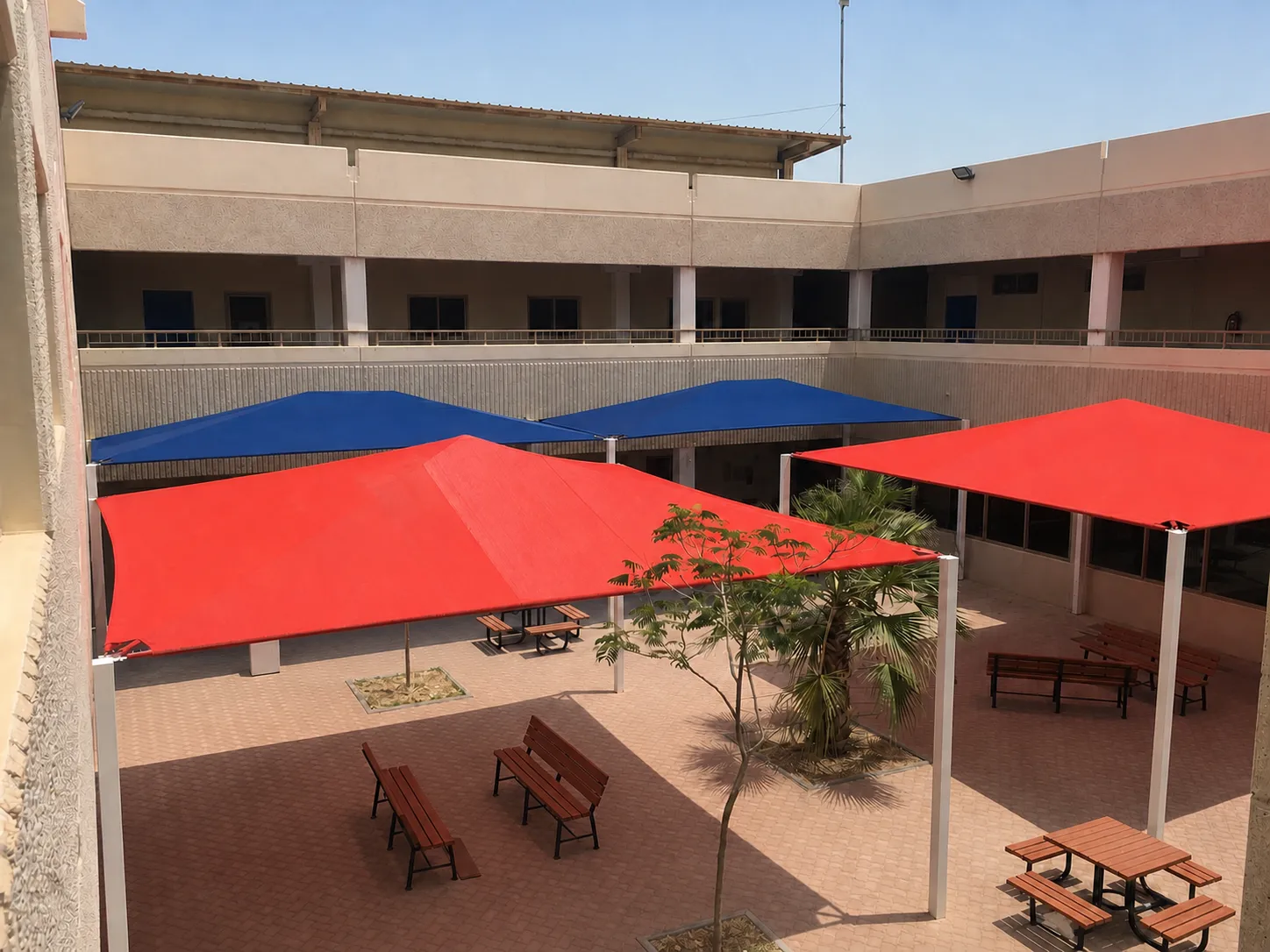
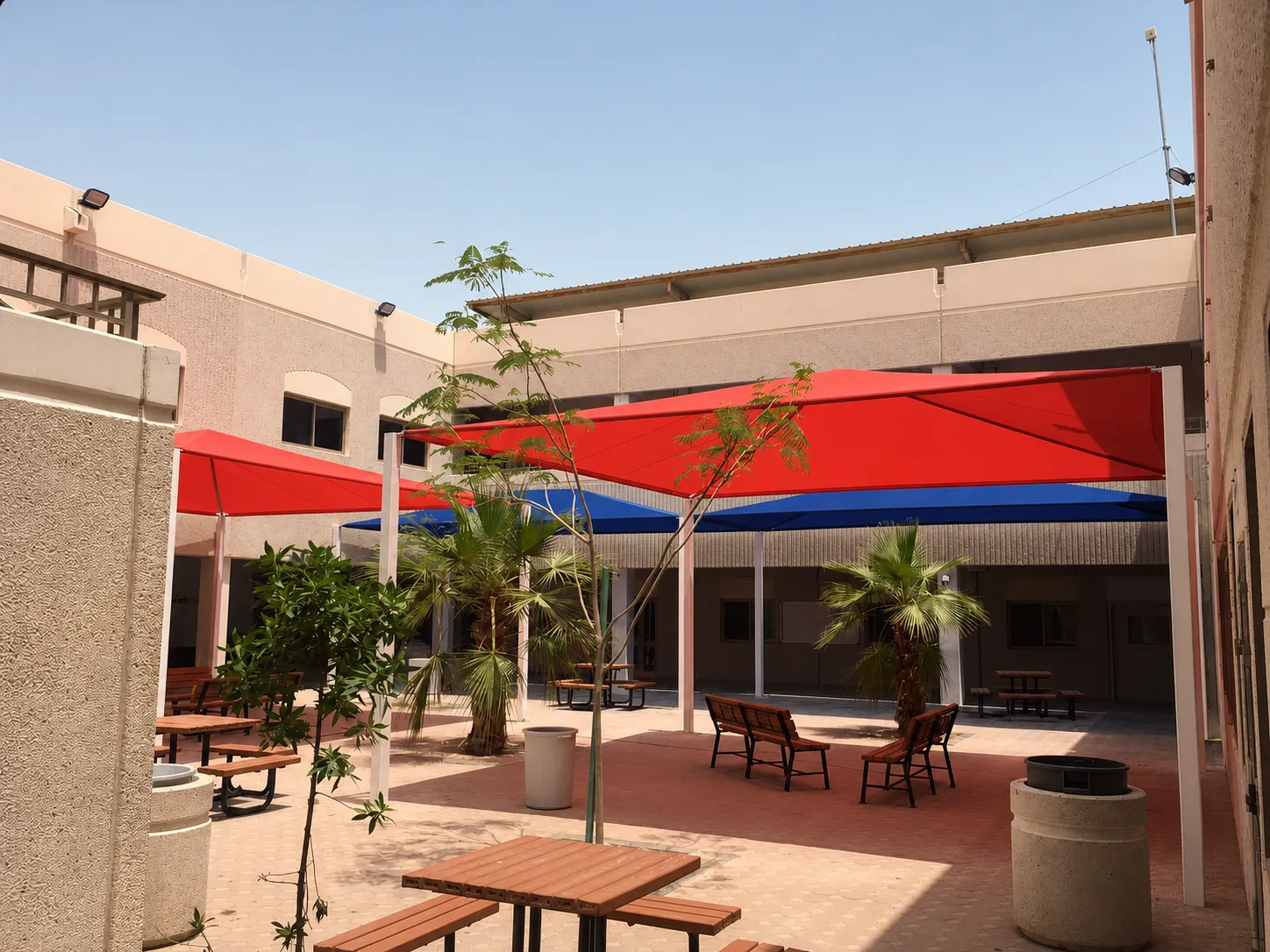
Original project photographs: a shaded school courtyard
The photographs come from the French School Al-Khobar album in the Shades Systems portfolio. They show red and blue coverings around an outdoor seating courtyard and support a discussion of shadow placement and circulation. They are not presented as photographs of an equipped playground, nor as evidence of dimensions, material grade or a safety certification.
Handover should include a usable maintenance plan
Request as-built information, covering and structure documentation, inspection and cleaning instructions, and the contracted warranty. Assign responsibility for reporting damage, slack coverings, connection changes or drainage problems, with an isolation and specialist-review procedure where necessary.
Plan maintenance access around product instructions and coordinate it with equipment and surfacing inspections without confusing their scopes. Retensioning, replacing a covering or moving a support requires a competent technical review, not an improvised adjustment by the operating team.
Start the project discussion with the actual play layout
Send Shades Systems the location, play-area layout, intended use hours, equipment plan, approved requirements and available site photographs. Ask the quotation to define responsibility for design, foundations, surfacing interfaces, installation and handover. This supports a site-specific shading discussion before a standard canopy shape is chosen.
Frequently asked questions
Does a shade structure alone make a playground safe?
No. Review the structure with equipment, surfacing, use zones, supervision and operating procedures. Shade alone does not certify compliance or suitability in every weather condition.
Will HDPE keep rain off the play area?
Do not assume this. Check the specific product and its water-passage limitations. If rain protection is essential, coordinate an appropriate covering and drainage system.
Can shade be added above an existing playground?
It can be investigated after reviewing equipment use zones, foundations, services, surfacing and construction access. Area measurements or photographs alone cannot confirm suitability.